About ReBuilt: A Strategic Framework for a Regenerative Built Environment
ReBuilt is a transformative global initiative that seeks to shift the construction sector from its current extractive, carbon-intensive model toward a regenerative practice. Led by Bauhaus Earth (BE), with the African Centre for Cities (ACC) as a regional partner, the project operates on the principle that the built environment, from individual buildings to neighbourhoods, the construction supply chains can become net-positive (Bauhaus Earth, 2024). This means construction processes should actively restore ecosystems, sequester carbon, reduce embodied and operational energy, and foster dignified livelihoods (Wahl, 2016; Reed, 2007).
The ReBuilt Demonstrator is an architectural design-build work that operates simultaneously on multiple registers: as a built structure in active community use; as a research output that has entered municipal policy review; as a living pedagogical environment; as a community resource whose use has exceeded its original brief; and as the material realisation of an intellectual argument first made in published form. That last claim requires explanation, because it is central to understanding what makes this work exceptional as a creative achievement.
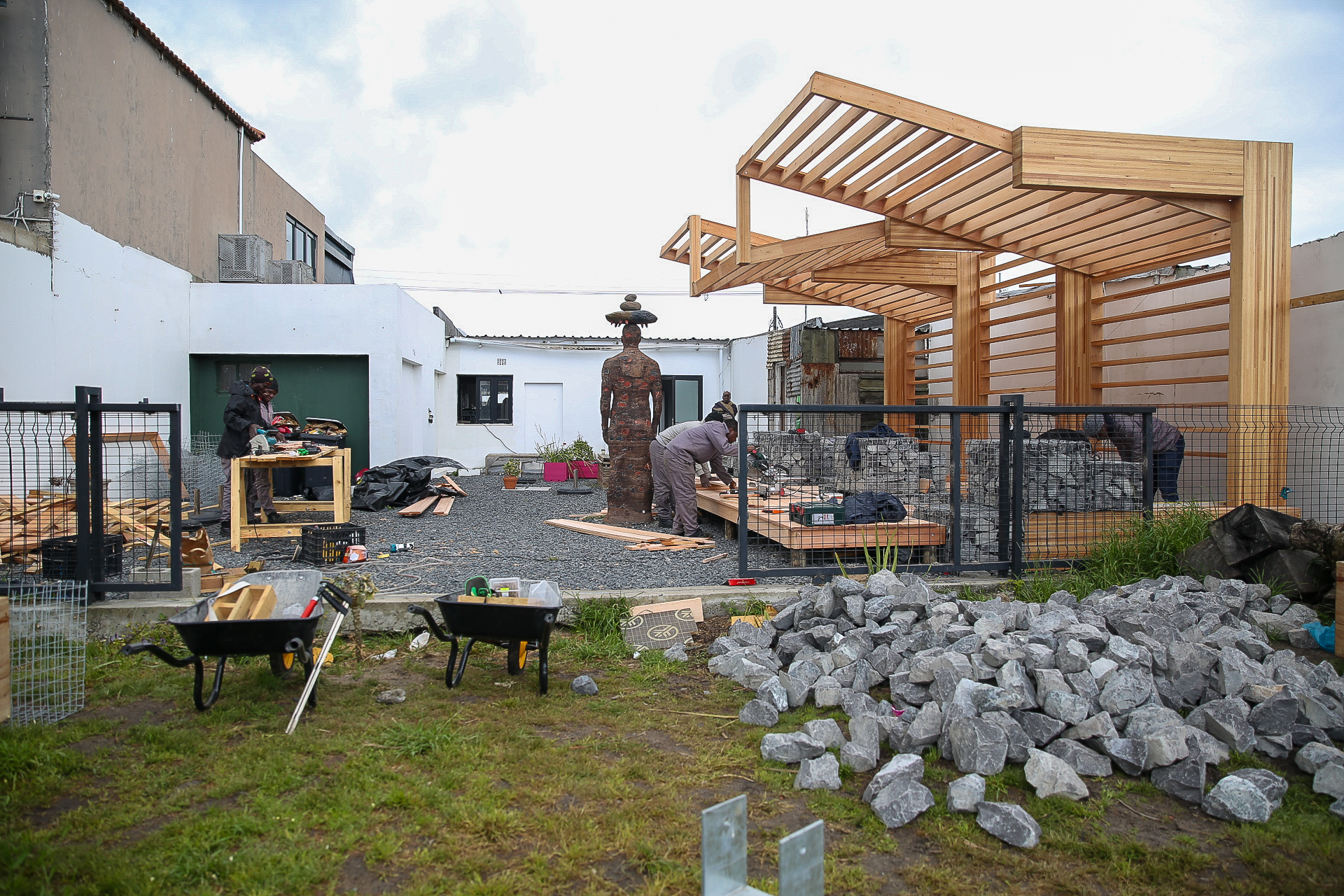
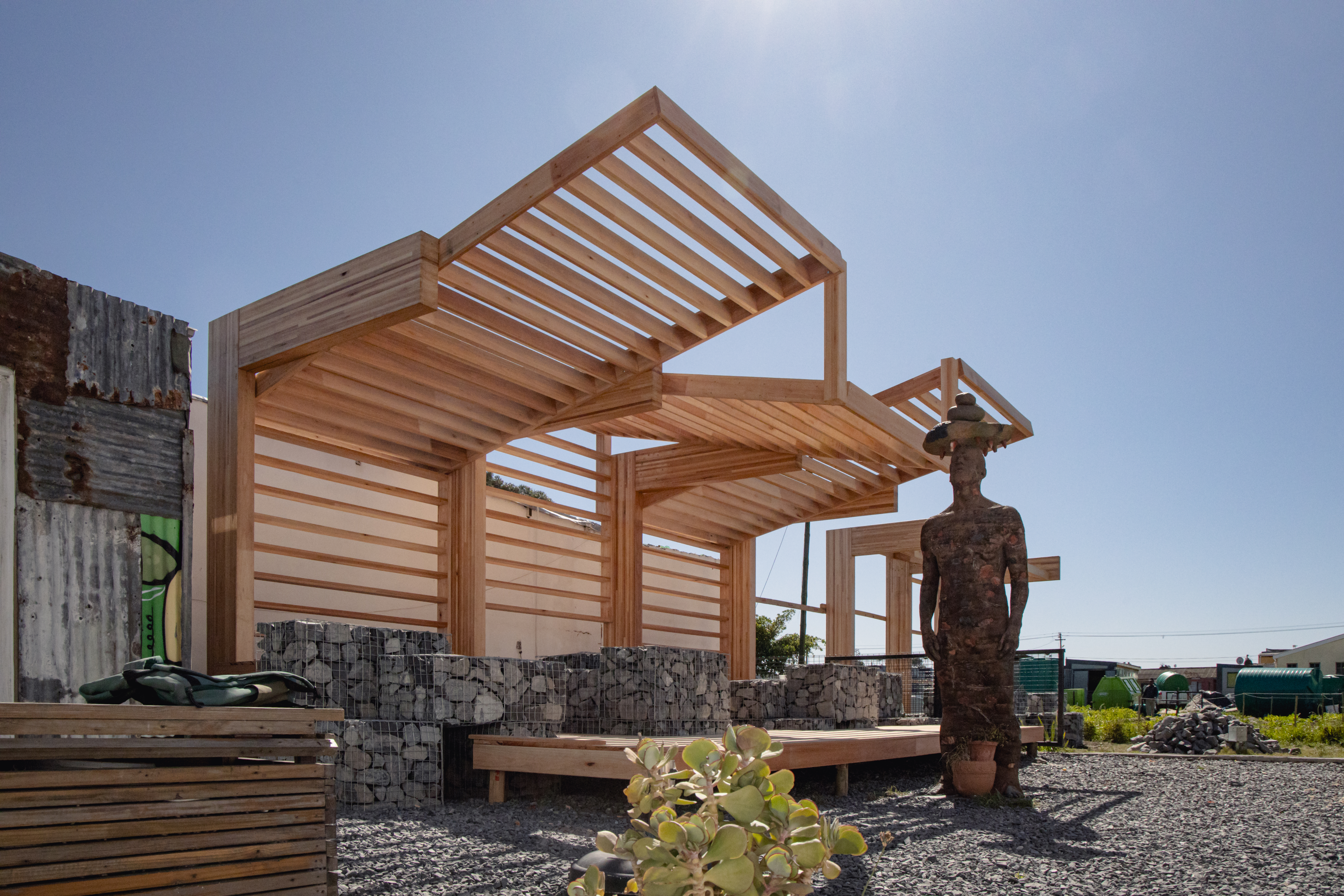
The Lerotholi Cultural Heritage Precinct in Langa is, in some form, the materialisation of that argument. The 16 on Lerotholi Art Gallery — established in 2019 by Mpilo Ncgukana, Thulani Fesi, Khanyo Ncgukana, and Shaun Williams as the first black-owned fine art gallery located in a black space, a township — is the cultural space. The Lerotholi Food Garden and Agrihub, operated by the South African Urban Food and Farmers Trust (SAUFFT) and the Masakhe Foundation on a 2,000 square metre plot, supporting 38 local food gardens and more than 300 small-scale farmers, is the enterprise incubator. The Langa Agrihub community shed, built by Kevin Kimwelle and students from the School of Explorative Architecture from recycled construction materials, is the urbanism lab. The ReBuilt Demonstrator, a Cross-Laminated Timber (CLT) pavilion physically situated between, and tangibly connecting, the gallery and the food garden, is the proof of concept that material innovation in construction can happen here, on this ground, within and at the edges of the systems that would ordinarily prevent it. Together, these four structures and programmes produce what no single one could produce alone, a thought experiment. The gallery gains an outdoor performance and gathering platform at precinct scale; and the food garden gains a permanent community space that has extended its public reach as a site whose significance is now legible at community, municipal, national, and continental scale.
The precinct did not arrive at this condition by institutional design. It assembled itself through collaboration, improvisation, and the willingness to work at a scale modest enough to survive the dangers to imaginations that Pieterse had warned about in that 2022 paper. What the paper named as a thought experiment, the precinct enacts as a living proposition. This relationship, between published intellectual argument and built creative form, is the work’s most distinctive quality and the clearest demonstration of what scholarship at ACC means in practice.
The site and its argument
The Demonstrator was built in the courtyard that links the gallery to the food garden. That position is the work’s first formal argument. Construction, culture, and food sovereignty are routinely separated in Cape Town by the sectoral logics of planning, funding streams, and professional expertise. The Demonstrator refuses that separation spatially. It creates a third condition — a place where the question of how to build differently is held in immediate proximity to the question of what art makes possible and the question of how communities feed themselves. Mpilo Ncgukana describes the pavilion as a much-needed third space, a landing for gallery visitors and a working area for locals. For SAUFFT, it provides the setting in which farmer Mzi Mashicila hosts his Tea with a Farmer Tastings, attended by community members, school children, and visitors engaging directly with sustainable agriculture. When Jazz in the Native Yards performed on its deck at the Open Streets Langa launch in October 2025, drawing several hundred visitors, notably the Mayor of the City of Cape Town Gordon Hill-Lewis, the structure was doing what it was designed to do: not a showcase behind glass, but infrastructure in active, unscripted use by the community it serves.
Proposition as policy
The transition to a regenerative built environment is not a technical project with social implications. It is a sociocultural transformation whose technical dimensions are among its most powerful instruments: what people regard as beautiful, what they aspire to inhabit, and what they can imagine being built in the places where they live are not secondary concerns but the conditions that determine whether any material innovation takes hold at scale. New construction systems cannot become normal in cities where the imagination of what a building can be has not shifted. But imagination alone is insufficient. The harder problem is that a city can pursue net-zero targets and still fail its most vulnerable residents, emitting less while excluding more, delivering a green transition that is spatially unjust and that leaves the communities most exposed to climate change still building with zinc and concrete because no viable alternative has been offered to them. The Demonstrator was designed in direct refusal of that failure: a regenerative building, built in a township, using materials specified for their simultaneous aesthetic, ecological, economic, and epistemic arguments, in a community whose cultural and agricultural life was already establishing the conditions for a different kind of city-making.
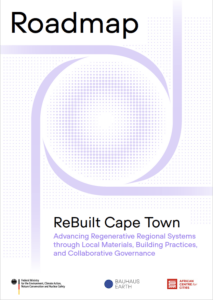
The ReBuilt Cape Town Roadmap (November 2025), co-produced with the City of Cape Town, industry, and civil society, translates this proof-of-concept into strategic pathways for city-scale transition across the low-income housing market, the short-term rental sector, material supply chains, and built environment education. It is currently under review by the City’s Urban Planning and Finance Directorates. The Demonstrator is not the conclusion of this work. It is the material point at which a peer-reviewed intellectual argument became a built proposition, one that is now certifiable, reproducible, inhabited, and under active consideration by the institutions that determine what Cape Town will build next.


Supporting portfolio: The ReBuilt Cape Town project brochure, is the primary visual and spatial record of the Demonstrator. It documents the design process from initial community engagement workshops through material specification and construction; the locality of the site within Langa and the broader city; the community ecosystem within which the structure is embedded; and the public activation of the precinct during Open Streets Langa. The written sections of this nomination should be read alongside it.
Community activation and continued use: The pavilion was publicly activated during Open Streets Langa on 26 October 2025, drawing several hundred visitors. It has since hosted SAUFFT’s Tea with a Farmer programme, Jazz in the Native Yards performances, and functions as a daily working space for gallery visitors and local community members. Mpilo Ncgukana, co-founder of 16 on Lerotholi, has documented its role as a catalyst for sustained community engagement across the precinct. SAUFFT has identified the model as one it wishes to extend to other projects in Langa and elsewhere, the clearest evidence that the community has taken ownership of the work.
Industry partnership: Construction and installation were led by Jamie Smily of XLAM South Africa, the country’s leading CLT manufacturer. XLAM’s involvement confirms that the material system is industrially reproducible and supported by an established local supply chain, distinguishing the Demonstrator from most academic research installations and substantially strengthening its transition from research output to replicable construction model.
Pedagogical engagement: UCT second-year architecture students undertook a studio project on the Lerotholi precinct, working in direct physical proximity to the Demonstrator and the Kimwelle/SEA shed, creating a live pedagogical context in which experimental construction with alternative materials was present as inhabitable reality rather than case study. This is the curriculum reform the ReBuilt Cape Town Roadmap identifies as a strategic regional priority and that the South African Council for the Architectural Profession’s current accreditation framework does not yet require.
Policy uptake: The ReBuilt Cape Town Roadmap (November 2025), co-produced with the City of Cape Town, industry, and civil society, is the primary evidence of policy impact. Currently under review by the City’s Urban Planning and Finance Directorates and national housing and environmental authorities, its significance lies in having emerged from a live, inhabitable proof-of-concept rather than a desktop study, a distinction that has consistently distinguished it in stakeholder engagements with municipal officials and professional bodies.
International programme standing: The Demonstrator is one of four global showcase projects in the Bauhaus Earth ReBuilt programme, alongside Bhutan, Indonesia, and Germany, positioning Cape Town as a peer contributor to a global inquiry into regenerative construction rather than a recipient of Northern expertise. Kevin Kimwelle’s Bauhaus Earth Fellowship in 2024 further consolidated the connection between the local design-build lineage on the Lerotholi precinct and the international programme within which the Demonstrator was commissioned.
Africa Urban Forum 2 (Nairobi, April 2026): The ACC exhibited the ReBuilt Demonstrator at AUF2, held in Nairobi on 8–10 April 2026 under the auspices of the African Union Commission, under the theme “Adequate Housing for All.” That a design-build research installation from a township courtyard in Cape Town — one that refuses the separation of construction, culture, and food sovereignty; that converts an ecological liability into a structural resource; that demonstrates a viable alternative to carbon-intensive building within the existing regulatory framework — was selected for exhibition before heads of state, ministers of housing, and urban development institutions from across Africa’s 55 member states, is itself the measure of the work’s reach. It confirms that what was built in Langa is legible far beyond Langa: a proof of concept that a different construction logic is possible, replicable, and already standing.
Scholarly foundations: The work is embedded within a sustained, multi-year body of research at the ACC that situates the Demonstrator within a coherent intellectual programme extending well beyond the life of this project.
The Cape Town ReBuilt project is supported by the German Federal Ministry for Environment, Nature Conservation and Nuclear Safety.
Project team:
- Prof. Edgar Pieterse – Project Lead
- Ass. Prof. Philippa Tumubweinee – Project Lead
- dr. heeten bhagat – Project Manager
- Ithra Najaar & Marlene Joubert – Project Finance and Administration
- Sarah de Villier and Daniel Xu – Strategic Support
Research assistants:
- 2023: Razaz Bashier, Julia Hope, Tshepo Mokholo, Russel Hlongwane
- 2024 – 2025: Aidan Africa, Mashego Molemane, Raíra Froes
For enquiries, contact: philippa tumubweinee at philippa.tumubweinee@uct.ac.za