

The African Centre for Cities (University of Cape Town) and the Urban School of Sciences Po (Paris) two highly rated institutions in Urban Studies worldwide, are launching a new collaborative master’s degree programme to begin in January 2027. The joint master’s draws on synergies between the two universities in cutting-edge interdisciplinary training in urban governance and urban policy. It provides students with the enriching experience and on-the-ground training in two dynamic global cities. Students spend their first semester in Cape Town, the second year in Paris, and return to Cape Town for the final semester of the programme.
The MPhil in African and Southern Urban Studies offers a unique opportunity to engage critically with the dynamics of urbanisation from the perspective of the Global South, with a strong focus on research. The programme combines rigorous academic training and applied learning in Cape Town and Paris — two urban laboratories facing complex development challenges.
The programme provides advanced interdisciplinary training in Southern urban theory and everyday urban life. Drawing on grounded, context-rich research and the vibrant intellectual environment of both institutions, students are placed at the intersection of theory, policy, and practice. They also have the opportunity to pursue fieldwork, internships, or capstone projects during their time in Cape Town and Paris.
Students in the programme will acquire the knowledge, skills, and experience to:
Professor Edgar Pieterse
Edgar Pieterse is the director of the African Centre for Cities
Dr Anna Selmeczi
Anna Selmeczi is a senior lecturer and the course convenor of the Masters in Southern Urbanism.
Dr Laura Nkula-Wenz
Laura Nkula-Wenz is a senior researcher and lecturer at the African Centre for Cities.
Professor Nancy Odendaal
Nancy Odendaal currently holds the University of Basel–University of Cape Town Professorship in Urban Studies,
Dr Nobukhosi Ngwenya
Nobukhosi Ngwenya research associate at the ACC. She facilitates City Research Studio 3 and Curating Urban Regulation.
Geetika Anand
Geetika Anand is a doctoral researcher and facilitates City Research Studio I of the MPhil in Southern Urbanism.
African Centre for Cities
Course convenor
Dr Anna Selmeczi
anna.selmeczi@uct.ac.za
+27 (0)21 650 5903
Urban School of Sciences Po
Academic Advisor
Cyriel Pelletier
cyriel.pelletier@sciencespo.fr
Dr Ruchi Chaturvedi, Sociology
Prof Francis Nyamnjoh, Anthropology
Dr Zwelethu Jolobe, Political Sciences
Dr Nomusa Makhubu, Fine Art
Prof Nancy Odendaal, Architecture, Planning and Geomatics
Prof Susan Parnell, Environmental and Geographic Science
Dr Julian Raxworthy, Architecture, Planning and Geomatics
Prof Harro von Blottnitz, Chemical Engineering
Dr Akin Adesokan, Indiana University
Prof Ash Amin, Cambridge University
Dr Thomas Asher, Columbia University
Dr Gautam Bhan, Indian Institute for Human Settlement
Prof Jo Beall, British Council & London School of Economics
Prof Teresa Caldeira, University of California, Berkeley
Prof Teddy Cruz, University of California, San Diego
Dr Divine Fuh, Council for the Development of Social Sciences Research Africa
Prof Alcinda Honwana, London School of Economics and Political Science
Prof Daniel Inkoom, Kwame Nkrumah University of Science and Technology, Kumasi
Dr Vyjayanthi Rao, Spitzer School of Architecture
Prof AbdouMaliq Simone, Max Planck Institute for the Study of Religious and Ethnic Diversity
Students begin the programme in Cape Town in January with the first semester of the Master of Philosophy in Urban Studies specialising in Southern Urbanism at the African Centre for Cities. At Sciences Po, students will be enrolled in the first year of the two-year Master’s programme “Urban Governance, Policy and Planning”, “Governing the Large Metropolis” stream, offered at the Urban School. Finally, during the last semester, students return to UCT to complete both coursework and a research component, culminating in the submission of a master’s dissertation. The courses from this final semester can be followed online, to allow students to deep-dive in field work.
During their group projects and learning expedition (at Sciences Po) and research (at UCT), students will work, both individually and collectively, in real situations of urban practice. Across the two universities, this immersion will encompass diverse sectors, including urban planning, urban services, transportation, real estate, housing, sustainable development, and smart cities, among others.
Providing all course requirements have been met, students will graduate after two years with both master’s degrees, one granted by UCT and the other by Sciences Po.
Students must validate coursework according to the requirements of the university at which they are studying each year.To earn both degrees, students must validate the academic requirements of both universities.
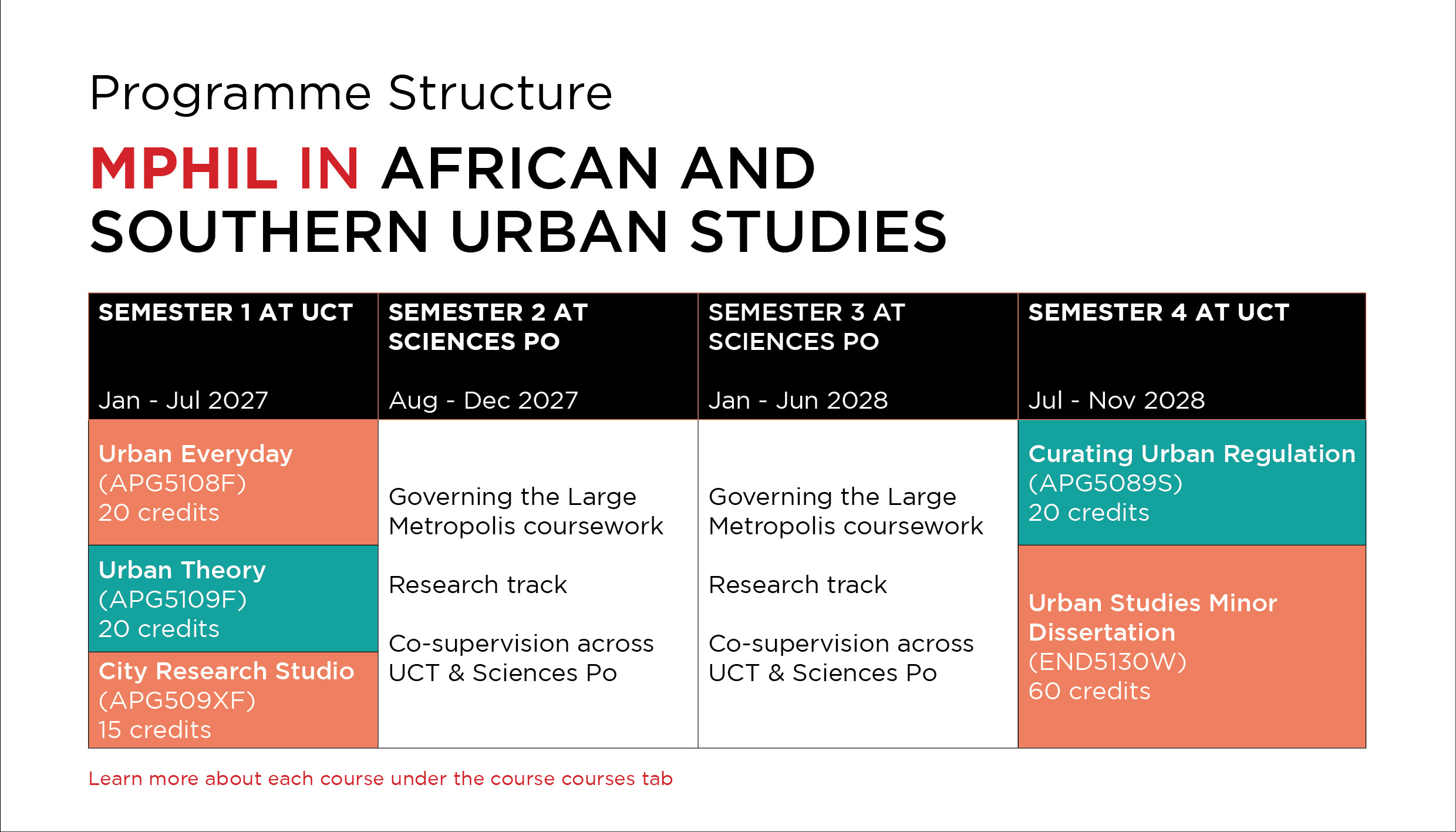
The City Research Studio is the cornerstone of the MPhil programme. It is a year-long compulsory course that runs alongside the core and elective modules. CRS is designed as learning context in which you will experiment with multiple forms of urban knowledge, expertise and research methodologies beyond the conventional classroom setting. It is a laboratory space where the students and faculty will learn to walk, see, smell, touch, embrace, explore and reimagine the city through intimate engagements with the aim of exploring and understanding the city.
The Urban Everyday approaches urban studies through literature grounded in everyday practices central to the dynamism that shapes African and southern city contexts and their transformations. The course reflects on the productive tensions in and between structural forces (the state, capital etc.) with ordinary forms of agency (citizenship, collective movements, and ordinary acts of encroachment) and thinks through the ways the everyday locates and disrupts theorising Southern cities.
The course sets out with the contention that urban theory is in crisis because it is not able to account for the diversity and innate complexity of urban worlds, especially as manifest in the Global South. The empirical basis of this contention is briefly explored before students are engaged to learn the craft of theoretical analysis and construction. Key urban theory works from the traditional canon and the Southern counterpoint will be explored to equip students to read critically, and ultimately be able to locate contemporary urban theory debates in a geo-historical context and place their own positionality within such a conceptual landscape.
The central question of this course is this: What does critical policy look like from the vantage point of African cities? It seeks to offer answers to this question through a design thinking methodology that investigates space and politics and what alternative modes of regulation are possible (given, for instance, constant technological innovation) and necessary (given the multiple and intersecting crises of access to water, food, housing and other basic needs). Students will be equipped to map, interpret and devise regulatory modes and practices of urban intervention that are capable of addressing the most pressing problems of our cities and transforming the places where people live.
A crucial component of the autonomous research in the MPhil is the minor dissertation. To graduate from this degree, students must complete a minor dissertation of 60 NQG credits and 15 000 words maximum. It is the chance to complete original research, engage in fieldwork, put methods into action and experience the satisfaction of producing original writing under expert supervision.
This collaborative degree programme is open to candidates worldwide with a diversity of backgrounds (Bachelors in Social Sciences, Architecture, Engineering, etc.). It is intended for aspiring academics and professionals interested in public or private sector careers with an international urban perspective.
To be eligible for admission to the UCT/Sciences Po Joint Degree Program, candidates must, at the time of enrollment in the Program, hold at least a Bachelors as ordinarily required for the admission to a Master’s degree. The programme is offered in English at both universities.
Apply directly on the Sciences Po website (online application only).
Students pay their fees:
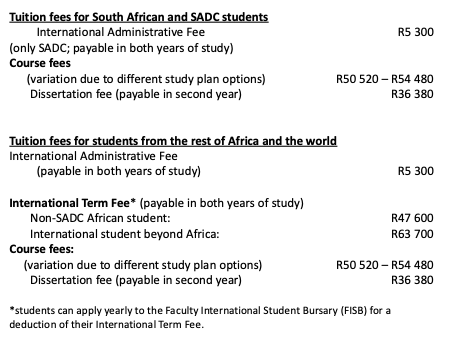
NB. The above fees are for the 2025 academic year, an increase can be expected for 2027.
To find out about possible funding, consult the grants offered by Sciences Po and UCT.
The MPhil aims to attract a diverse and interdisciplinary cohort and therefore encourages international students from Africa, the Global South and elsewhere to apply for the course. To find out more about fees, VISA applications and other considerations for international students go to www.iapo.uct.ac.za
The Sciences Po – UCT Collaborative Degree offers access to stimulating career paths in both South Africa and France, while also providing strong professional training in a comparative and critical research approach within the Global South.
The degree prepares graduates for careers in the public sector, nonprofits and NGOs, international organisations, utility firms, planning agencies, applied research organisations, consulting firms, and development agencies.
Candidates to the collaborative degree programme apply directly on the Sciences Po website (online application only)
Comprehensive information about the application process is available on the Sciences Po website.
Applications for the 2027 study year open in October 2025.
The deadline for applications is 29 March 2026.