“If Cities Could Speak: Vulnerability, Climate and Health in the City” is a collaborative, interdisciplinary initiative hosted by the African Centre for Cities (ACC) at the University of Cape Town. It forms part of a broader international project led by the Indian Institute for Human Settlements (IIHS), with additional hubs in South Africa (led by ACC), Kenya (led by Kounkuey Design Initiative – KDI), and Sierra Leone (led by Sierra Leone Urban Research Centre – SLURC). The project investigates how people experience climate images on their health, with a focus on vulnerable settlements.
Running from April 2024 through April 2027, this project is funded by the Wellcome Trust, operating under its climate and health thematic portfolio. The research addresses an urgent need: to unpack how climate-related hazards—ranging from everyday stresses like poor air quality or water scarcity to episodic floods and systemic pressures such as ecosystem degradation—interact with existing vulnerabilities in vulnerable settlements in Kenya, India, South Africa, and Sierra Leone (KISS).
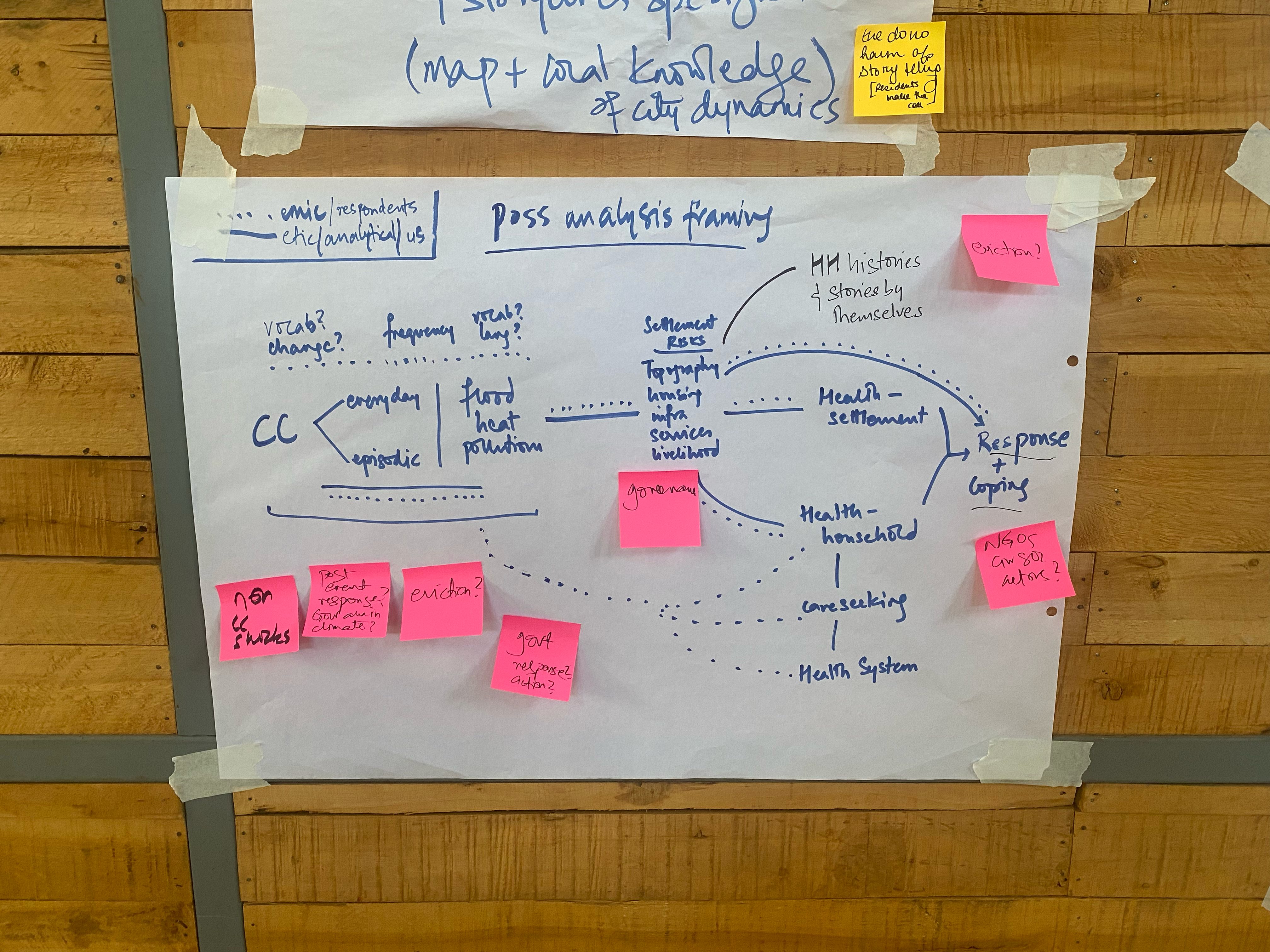
A primary aim is to explore how these climate-health burdens are lived and understood by residents themselves. The project employs a mixed-method approach that integrates spatial analyses (e.g. GIS mapping) with qualitative techniques such as health history interviews and participant observation to capture vernacular narratives of vulnerability, risk perception, and coping practices grounded in local realities.
Teams will co-produce visual narratives and evidence-based insights that spatially link climate hazards and health outcomes. These outputs are designed for accessibility, employing diverse formats—visuals, short films, media—to engage both academic and non-academic audiences effectively.
The project aims to bridge disciplines—urban planning, climate science, public health, anthropology, storytelling—around a shared objective of more inclusive climate resilience. By foregrounding community knowledge and lived experience, it offers valuable insights for policymakers and planners on designing interventions grounded in context-sensitive, equitable adaptation strategies. Overall, “If Cities Could Speak” not only generates actionable evidence for urban policy and practice but also elevates vernacular perspectives in global debates on climate and health.